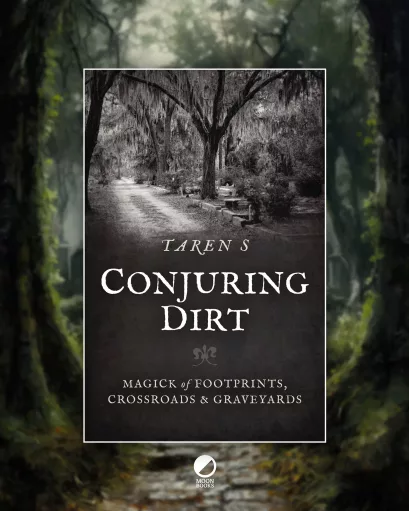
I’ve always had a fondness for dirt. As a child, nothing made me happier than making mud pies in my backyard. Back then, I had no idea how remarkable dirt truly was. Even now, I feel most at home in nature; my mind is calmest when I’m deep in the woods, inhaling the earthy scent rising from the leaf mulch beneath my feet.
In recent years, I’ve become fascinated by the mycelium networks that weave forests into living conversations. Yet soil is far more than a biological support system. It is memory, relationship, and story compressed beneath our steps. In Conjuring Dirt, Taren S sets out to reveal a use for soil that is even more underground, pun very much intended.
From its very title, Conjuring Dirt invites readers to reconsider the ground we often overlook. With a voice that is grounded, informed, and laced with wit, Taren transforms what many see as an ordinary substance into a powerful, multi-layered resource for modern practitioners and folk magic enthusiasts. Drawing from her broad experience, she guides readers through Rootwork and American Southern Folk Magic, while thoughtfully engaging with Hoodoo and other African American traditions.
I hope you enjoy this review.
What This Book Is About
The central concept of Conjuring Dirt is straightforward yet profound: earth carries inherent qualities that can be worked with intentionally. The soil beneath us not only supports life but also holds narrative, energy, and potential for spiritual practice shaped by human action, history, and spirit presence.
Taren organises the book into three primary categories of “working dirt”:
- Purposeful dirt sourced from footprints and specific locations
- Crossroads dirt associated with transitional and liminal spaces
- Graveyard dirt linked to ancestors and potential spirit collaborators
Rather than offering a superficial overview, the book reads like a practical and philosophical almanac, exploring these environments in depth while addressing both ethical and hands-on considerations. Place is not treated as abstract symbolism here, but as something relational and responsive.
Style and Voice
Taren’s writing strikes a rare balance between wisdom and warmth. This is not a dry instructional manual. The book is alive with folktales, historical snippets, and personal reflections that root the practice in lived experience. Her personality comes through clearly, and the playful, often wry humour keeps the material engaging without undermining its seriousness.
What I Loved
- Rich context – Taren doesn’t simply explain how to collect dirt; she explains why different soils carry distinct qualities and how intention, location, and action interact.
- Crossroads work – The exploration of liminal spaces is a standout, both practical and philosophical, expanding how readers may understand places that exist betwixt and between.
- Respect for ancestors and land – Graveyard dirt is handled with care. Respect, consent, and reciprocity are emphasised throughout, with clear warnings that misuse or neglect of offerings carries consequences.
Considerations & Nuance
This is not a light read for the casual spiritual shopper. Practitioners who hold a strongly “love and light” framework may feel challenged, particularly around working with soil from places associated with death or deep ancestral memory. Personal boundaries, cultural awareness, and local laws are all treated as essential considerations rather than afterthoughts.
The structure of the book can feel intentionally eclectic, weaving folklore, narrative, and practical exercises in a non-linear way. For some, this will feel organic; for others, slightly untidy.
There is also a moment of internal tension in places, such as when Taren states that Goofer Dust recipes should not be altered, while also offering multiple examples and acknowledging that historically, everyone had their own recipe. This doesn’t undermine the work, but it is a point that invites critical reflection.
Who This Book Is For
Conjuring Dirt will resonate with readers interested in:
- Earth-based magic and folk traditions
- Liminal spaces and the spirit of place
- Ancestral connection through physical matter
- Practical, grounded ritual work
It will be especially rewarding for those comfortable with grassroots magic and experiential learning. This is not a book of doctrine, but one of embodied relationship.
Final Verdict
Taren S’s Conjuring Dirt transforms the overlooked and underfoot into something potent and alive. It encourages readers to take the land they already inhabit seriously, reminding us that powerful magic is rarely exotic. More often, it is waiting exactly where we stand.
Discover more from The Scouse Druid
Subscribe to get the latest posts sent to your email.